Blog 1
HOW AMAZON CLOUDFRONT DELIVERED MASSIVE TRAFFIC FOR FIFA WORLD Cup 2026
Every World Cup, the biggest “headache” for broadcasters and OTT streaming platforms isn’t just about broadcasting rights, but how to smoothly deliver live streaming video to tens of millions of concurrent viewers. Any interruption or lag right at the moment of a goal can create a massive wave of outrage on social media.
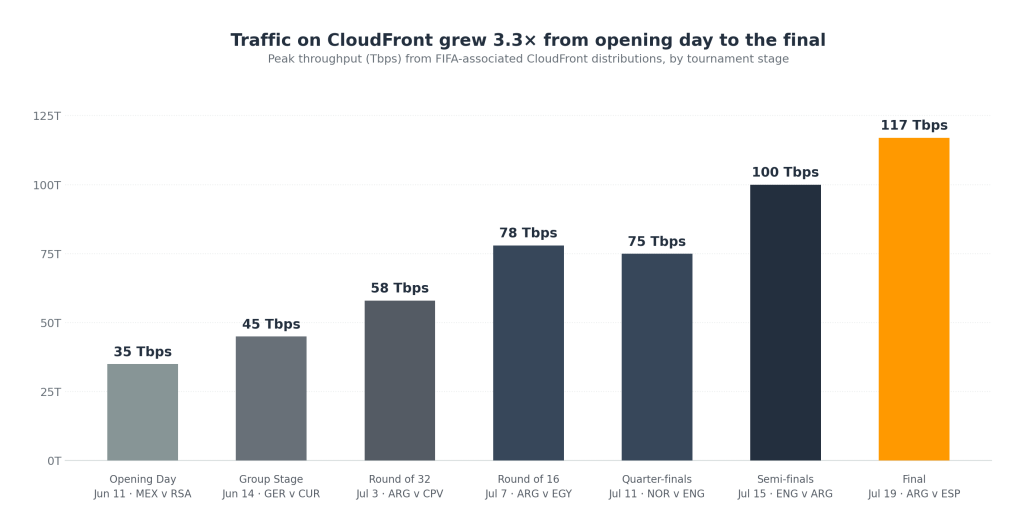
A recent AWS blog post about how they used Amazon CloudFront to shoulder the massive traffic during the FIFA World Cup 2026 showed us the incredible power of a modern Content Delivery Network (CDN).
Context: When traffic spikes with every pass
Unlike Video on Demand (VOD) where viewers are scattered, sports Live Streaming experiences extreme “traffic spikes”. Imagine millions of devices opening the app simultaneously when the starting whistle blows or during a penalty shootout.
If all these requests hit the Origin Server directly, it would undoubtedly overload and crash immediately (the thundering herd problem). The challenge is having a buffer large enough to absorb this massive wave while maintaining the lowest possible latency so viewers don’t hear their neighbors cheering “GOAL” before the ball even rolls on their screen.
KEY HIGHLIGHTS:
- Global Edge Location Network: With hundreds of Points of Presence (PoPs) scattered worldwide, CloudFront brings the video stream closest to the end-users. Viewers in Vietnam will fetch data from servers in Vietnam or Singapore instead of pulling the video all the way from the US.
- CloudFront Origin Shield - The steel shield protecting the origin: This is the “secret weapon” of this architecture. Instead of letting each Edge Location globally call the Origin when a video isn’t found (cache miss), CloudFront routes all these requests through a centralized layer called Origin Shield. This layer consolidates millions of identical requests into just 1 request sent to the origin, reducing backend load by up to 99%.
- Dynamic Caching: For live streaming, video segments are only a few seconds long. CloudFront is highly tuned to cache these video segments instantly with millisecond latency, delivering HLS or DASH packets to user devices as smoothly as possible.
- Security with AWS Shield Advanced: Global events are always prime targets for hackers. CloudFront comes integrated with AWS Shield to automatically detect and mitigate Terabit-scale DDoS attacks without affecting the experience of legitimate users.
REAL-WORLD SCENARIO:
Imagine the 2026 World Cup final has a decisive penalty at the 90th minute. The news explodes, and within 10 seconds, an additional 5 million users open the app to watch.
The CloudFront processing flow would unfold as follows: User → Edge Location (Nearest) → Origin Shield → Origin Server (AWS Elemental MediaPackage)
- 5 million users simultaneously request video segment #1024 (the moment of the penalty kick).
- Edge Locations in respective countries receive the requests. Since this video segment is brand new and not in the cache, the Edge Locations forward the request to the Origin Shield layer.
- Origin Shield receives tens of thousands of requests from the Edge Locations, consolidates them all, and sends only 1 single request to the Origin Server.
- The Origin Server comfortably returns video segment #1024.
- Origin Shield caches it and replicates the video back to the Edges, which then distribute it to the 5 million users.
All this happens in the blink of an eye, while the origin server remains completely unaware of the 5-million-user “storm”.
CONCLUSION:
The most impressive thing about this system is its ability to turn an incredibly complex scaling problem into a smooth process through a “Multi-tier caching” strategy.
Today, CloudFront is no longer just a place to store static images or CSS/JS files. The combination of Edge Locations and Origin Shield has made it the backbone of the modern live broadcasting industry. It demonstrates the core philosophy of the Cloud: “Let all the heavy lifting happen at the Edge, and keep the Core server safe and relaxed”.
This is a classic case study for any system requiring the delivery of static data/media to a massive number of concurrent users without “burning money” to maintain a gigantic fleet of servers.
Original AWS blog post: How Amazon CloudFront delivered traffic for the FIFA World Cup 2026
Original post on AWS Study Group: Original Post