Blog 2
CENTRALIZED NETWORK TRAFFIC INSPECTION WITH AMAZON VPC ROUTE SERVER AND AWS TRANSIT GATEWAY
One of the biggest “headaches” for Cloud Network Engineers is maintaining security control as the system balloons with tens or hundreds of different VPCs. Deploying firewalls in every single VPC is far too expensive, but when you consolidate them into a centralized hub, managing network routing becomes a manual nightmare.
That is why AWS’s recent blog post about combining Amazon VPC Route Server and AWS Transit Gateway to create a fully automated Inspection VPC architecture offers such a groundbreaking solution.
Context: The Nightmare Called “Static Routes”
Previously, the standard approach for inspecting network traffic between VPCs was to use a Hub-and-Spoke architecture with AWS Transit Gateway. All traffic from spoke VPCs would be routed to a central VPC (Inspection VPC) containing third-party firewalls (Palo Alto, Fortinet, Check Point, etc.).
The problem is, inside this Inspection VPC, directing traffic through the correct firewalls requires you to manually configure Route Tables (Static Routes). When the system auto-scales (adding or removing firewalls), or when a firewall fails, you need complex Lambda scripts to intervene and update the Route Tables. If a script fails, traffic drops (blackholes), causing downtime for the entire system.
KEY HIGHLIGHTS:
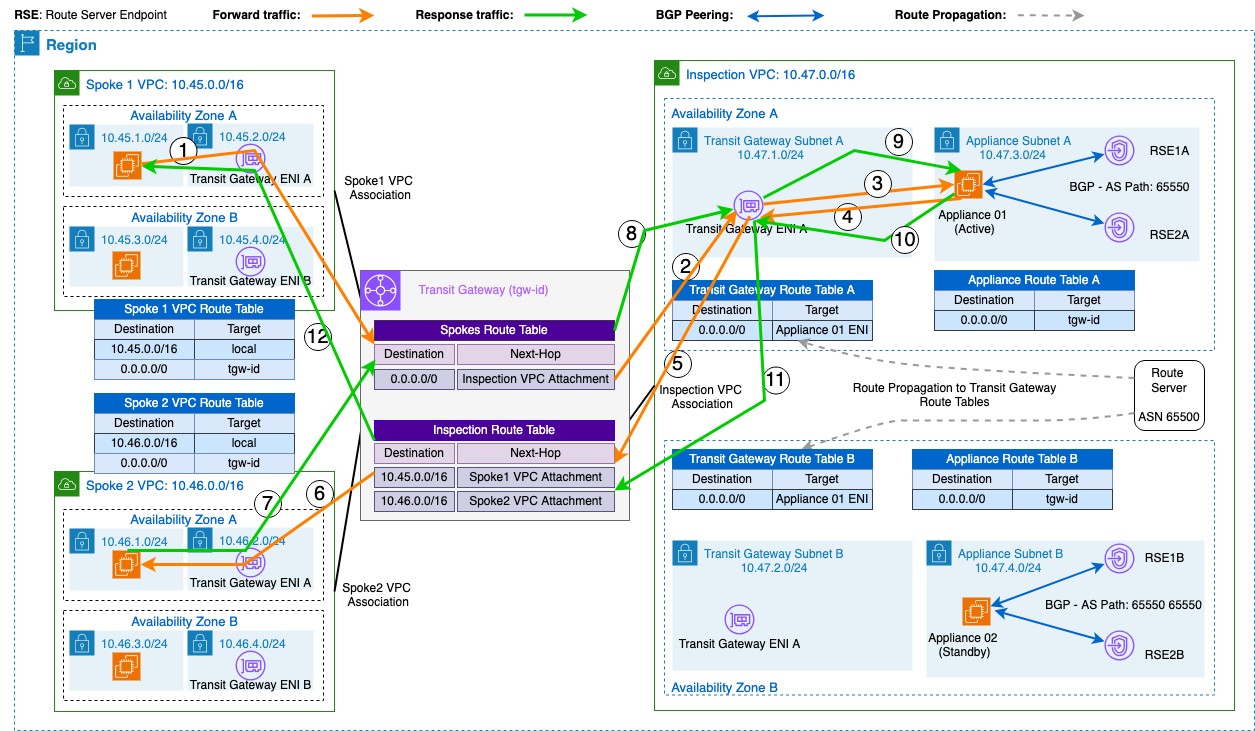
- AWS Transit Gateway (TGW) as the central hub: TGW acts as a central “roundabout”, connecting all Spoke VPCs together and forcing all traffic streams (between VPCs or to the Internet) through the Inspection VPC for scanning first.
- Amazon VPC Route Server - The dawn of dynamic routing (BGP): This is the “star” of the new architecture. VPC Route Server allows Network Virtual Appliances (NVAs) to use the Border Gateway Protocol (BGP) to communicate directly with the VPC’s network infrastructure.
- Complete elimination of manual operations: Instead of manually editing Route Tables, firewalls now automatically “advertise” their network routes to the VPC Route Server via BGP. The AWS system automatically reprograms the VPC Route Tables based on this BGP information.
- Real-time High Availability: If a firewall appliance goes down or requires maintenance, the BGP session automatically drops. The VPC Route Server instantly detects this, withdraws the route, and shifts traffic to healthy operating firewalls without any human intervention.
REAL-WORLD SCENARIO:
Imagine a Web Server in Spoke VPC A needs to query data from a Database in Spoke VPC B. Security policies mandate that this data stream must be scanned through an IPS/IDS firewall system to prevent attacks.
The processing flow is as follows: Web Server (VPC A) → Transit Gateway → Inspection VPC → Firewall (NVA) → Transit Gateway → Database (VPC B)
In this new architecture:
- You enable Auto Scaling for the Firewall (NVA) cluster.
- When traffic spikes, a new Firewall instance is created.
- As soon as it boots up, this Firewall establishes a BGP connection with the Amazon VPC Route Server, essentially saying: “I am ready to receive traffic.”
- The VPC Route Server automatically updates the Inspection VPC’s Route Table to Load Balance traffic to the new Firewall.
- A few days later, when the load drops, the Firewall is terminated. The BGP connection drops, and the Route Server automatically removes the corresponding route from the Route Table. Zero downtime, zero manual effort!
CONCLUSION:
What impresses me the most about this solution is how AWS brings telecom-grade network protocols (BGP) deep into the Cloud infrastructure (VPC) to completely resolve manual operational issues.
Instead of maintaining dozens of custom Lambda scripts just to keep Route Tables accurate during infrastructure changes, network engineers can now fully trust the automatic synchronization capabilities of BGP via the VPC Route Server.
This is a textbook case study for Enterprise systems that require stringent security (mandatory Inspection VPCs) while optimizing costs and operational effort. No matter how complex a network gets, as long as routing can be automated, the system is truly “Cloud-native”.
Original AWS blog post: Centralized VPC inspection with Amazon VPC Route Server and AWS Transit Gateway
Original post on AWS Study Group: Original Post