Event 1
Event Report “Agentic AI Build Week Demo Day”
Purpose of the Event
- Explore innovative solutions combining the power of Generative AI and Agentic AI (especially Amazon Bedrock and AgentCore) to solve real-world problems.
- Learn best practices in building automated AI systems on the AWS platform.
- Connect and learn from the top teams about deploying Multi-Agent models, Computer Vision, and Serverless architectures.
List of Speakers (Team Representatives)
- Team 3KA - Presented S.H.E.P.H.E.R.D (Crowd Management via Computer Vision)
- Team OneTeam - Presented AI-Powered Conversation Ordering (KFC Bot Agent)
- Team Plan V - Presented Solution Architect Professional Native App
- Dream AI Team - Presented Signal Scout (Corporate Strategy Signal Analysis)
Key Highlights
S.H.E.P.H.E.R.D (Team 3KA)
- Problem solved: Real-time crowd management, replacing manual monitoring with automated congestion detection and alerts.
- Core Technology: Combined YOLO + ByteTrack for Computer Vision.
- Agentic Layer: Used Autonomous Monitor for continuous supervision and Operator Copilot to allow operational staff to query via natural language using Amazon Bedrock AgentCore.
KFC Bot Agent (Team OneTeam)
- Problem solved: Reduced drop-off rates by eliminating the need for customers to download a new app, letting them order directly within Zalo/WhatsApp chat frames.
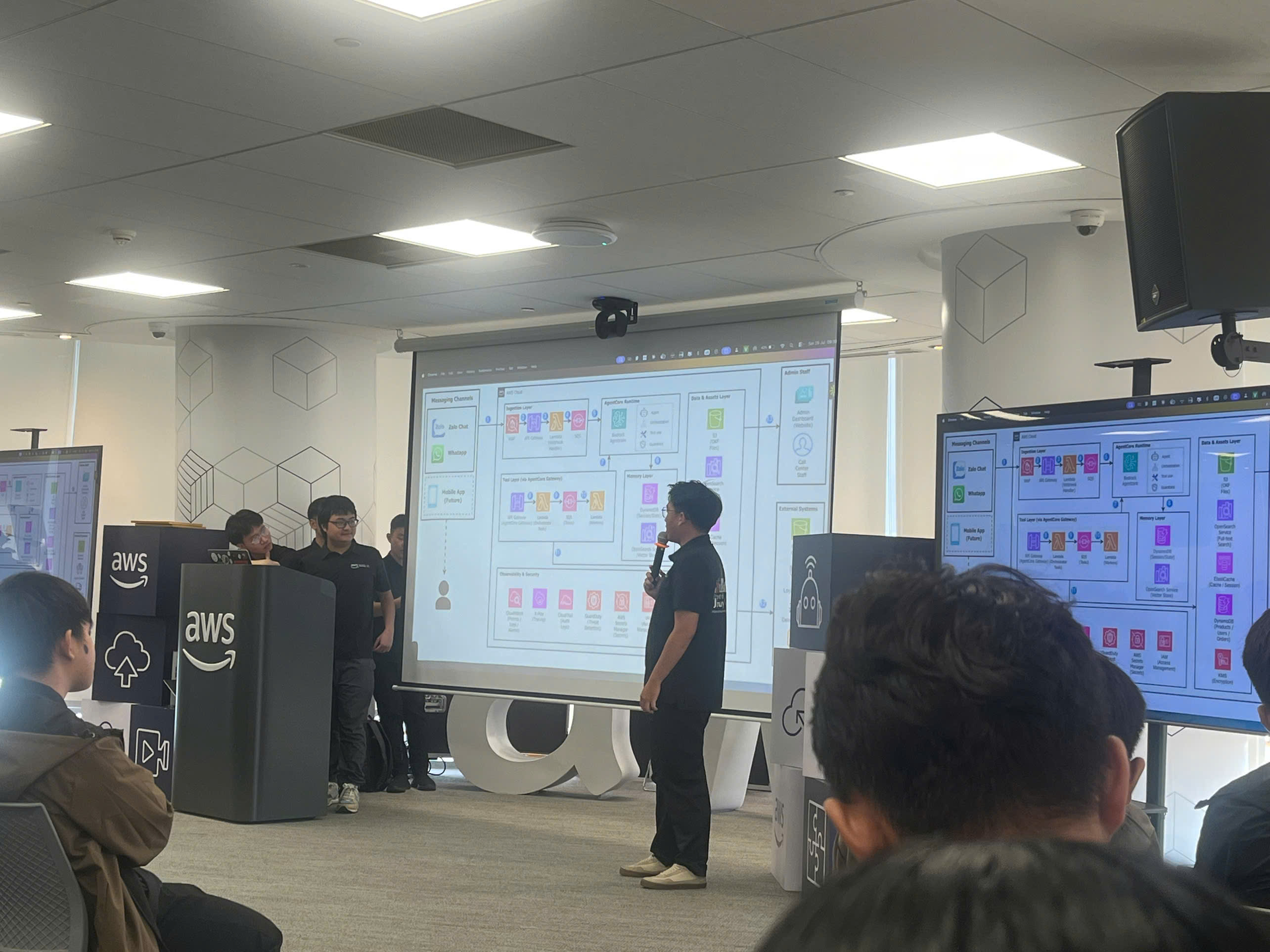
- Operational Flow: Applied a “Goal -> Plan -> Tools -> Act -> Verify” loop. The Bot automatically checks carts and applies promotions through OpenSearch and DynamoDB.
- Cost optimization: Latency of just 3-5 seconds, with incredibly low costs (~$0.006/order) thanks to a Serverless AgentCore architecture.
SA Professional AI Native App (Team Plan V)
- Problem solved: Automated architecture design tasks, requirement extraction, and cost estimation for Solution Architects.
- Supported Tools: Integrated AWS Pricing MCP and Draw.io MCP to draw visual diagrams and provide projected costs directly during chats.
Signal Scout (Dream AI Team)
- Problem solved: Automated competitor data collection and analysis rather than scattered manual research.
- Multi-Agent Architecture: A Crawler Subagent gathers data (via Apify, LangFuse), then an Analysis Subagent processes it, assesses risks, and provides visual report dashboards for management.
What I Learned
Design Thinking
- Agentic AI superseding pure Generative AI: AI no longer stops at text generation but has advanced to automatic Tool Use and Action decision-making.
- Design Once | Deploy Everywhere: Optimizing the core architecture to plug into various chat channels (Zalo, Messenger) without having to rebuild from scratch.
Technical Architecture
- Serverless & Microservices: Fully utilizing ECS Fargate, Lambda, and DynamoDB to ensure the system can auto-scale at the lowest possible cost.
- Model Context Protocol (MCP) Integration: Using MCPs to provide context and intervention rights to external APIs for the Agent.
- Context Management (Memory Layer): Separating Short-Term Memory and Long-Term Memory (vector databases like OpenSearch) to maintain seamless context in chat flows.
Modernization Strategy
- Automating AI Routing: Applying Multi-Agent systems to break down complex problems into Subagents responsible for specialized stages (Crawler, Analyzer, Reporter).
- Focusing on Cost-efficiency: AWS aims to build architectures that are not only powerful but also cheap and optimized (e.g., the KFC Bot project costs only $0.006/request).
Application to Work
- Applying AgentCore to chatbot projects: Upgrading current chatbot systems from Rule-based to Agentic-based so chatbots can automatically look up internal databases.
- Using MCP in programming: Integrating AWS Pricing MCP to quickly provide cost estimates during architecture proposals for clients.
- Improving attendance processes (Project BK-Sync): Further researching Computer Vision to potentially identify student faces automatically alongside QR codes in the future.
Event Experience
Attending the Agentic AI Build Week Demo Day was an eye-opening experience, demonstrating the high practicality of AI when applied to Enterprise problems.
Learning from experts and young engineers
- Despite the short Hackathon duration (typically 24h - 48h), teams created complete products with incredibly impressive latency and costs.
Practical Technical Experience
- Understood the design lifecycle of an Agentic System from the Ingestion Layer -> AgentCore Runtime -> Tool Layer -> Data & Assets Layer.
- Realized the power of combining AWS Bedrock with built-in security services (WAF, Cognito) to create safe AI systems for enterprises.
Key Takeaways
- Preparation (A clear goal, ready toolkit, defined roles) is the deciding factor in building products rapidly.
- Today’s AI systems must not only be smart but also “explainable” and “actionable”.
Event Photos